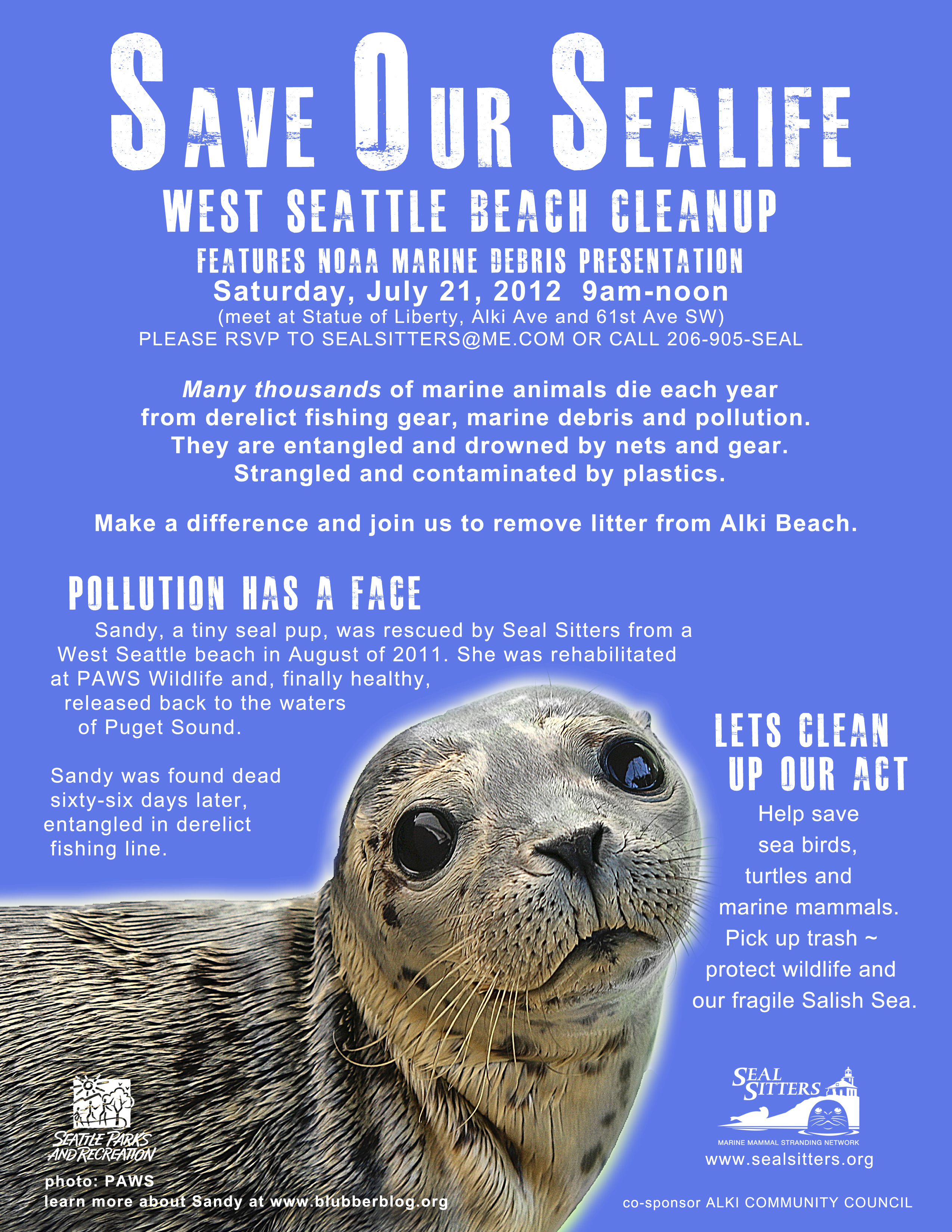
Seal Sitters on high alert for seriously wounded seal pup
The fact that the pup was quite alert and positioned close to the water’s edge made the likelihood of a successful rescue very dubious. More likely than not, instead of being able to capture the pup, responders would have scared him into the water. Since he/she desperately need rest and the beach was secure from human harassment, we decided to let him rest in hopes for a chance of rescue today. The pup slept pretty soundly the rest of the afternoon and responders made arrangements with PAWS Wildlife Center, recently on overload with oiled geese, to ensure they had space to treat the pup.
We ask that the public call Seal Sitters’ hotline @ 206-905-SEAL (7325) immediately upon seeing a seal pup onshore. Only members of NOAA’s Marine Mammal Stranding Network have the authority to handle marine mammals. Please stay far back and keep dogs leashed. It is urgent that we get the pup medical attention from this human-caused injury. Thanks to Tracy and the West Seattle Blog for helping us spread the word for people to be on the lookout.
The pup was named Dreidel by Seal Sitters volunteer Noelle and friend Karen out for a stroll at the waterfront park. The name is in honor of the first day of Hanukkah. This is the third seal pup this week that Seal Sitters has responded to along the shores of Elliott Bay.
Marine debris and toxic trash can cause entanglement, serious injury and death to marine marine mammals and other sea life. Read more on Seal Sitters’ website in our newly expanded marine debris section.
Sunny day brings seal pup Cloudy to the beach
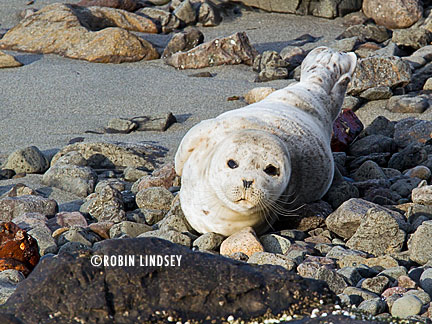
While setting the perimeter, a quick call was made to Lynn S, scheduler for the day. She immediately consulted our online volunteer calendar and called those who had entered time for the late afternoon and evening hours. Shortly thereafter, volunteers Lars, Betty and Ralph showed up for duty with their binoculars and educational materials - ready to protect the pup and educate the public about harbor seal behavior. Next, came Angela and her 9-year-old son Jack eager to help out. The youngster named the pup Cloudy.
Volunteers Theresa, David and Eilene stayed until well after dark. Cloudy returned to the Sound at almost 8 o’clock when the high tide washed over him. The pup was beginning to shiver by that time in the cold air with damp fur. Since weaned pups tend to be on the thinner side with less of a blubber layer to keep them warm, it would be the equivalent of a person being out in the cold with a windbreaker instead of an insulated down jacket.
Cloudy hasn’t shown up yet today, but may reappear this afternoon after a late-morning high tide in excess of 12 feet. Angela reports that Jack woke up early this morning and the first thing out of his mouth was “I wonder if Cloudy came back to the beach?” We certainly hope so - and rest assured that if he does return, volunteers will be protecting him on these busy urban shores.
While scouring the shoreline for signs of pups early this morning, our first responder noticed some derelict net caught in the rocks below the sea wall. We will attempt to remove that today so that this treacherous piece of marine debris can no longer endanger marine wildlife.
UPDATE 2:00pm
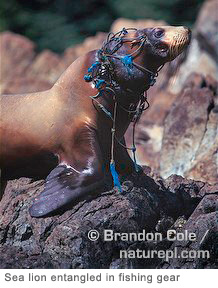
Using a rope ladder, first responders Robin and David scaled the sea wall and cut away a substantial piece of “ghost net” that was lodged between the rocks and high cement wall close to where Cloudy rested yesterday. This term refers to a derelict fishing net - a deathtrap that has been lost or cut free by fishermen which drifts through the water, catching and drowning marine wildlife.
If you come across derelict fishing gear, you can report the type and location online through Northwest Straits Initiative’s website here. Countless thousands of marine mammals, sea turtles and sea birds die each year in derelict fishing line, pots and nets. In Puget Sound alone, as of late September, 2013, the Northwest Straits Initiative has “removed 4, 527 derelict fishing nets, 3,081 crab pots and 47 shrimp pots from Puget Sound. More than 323, 000 animals (240 unique species) were found entangled in this gear.” We applaud their tremendous - and often perilous - environmental work.
No "butts" about it - Alki Beach cleanup a success
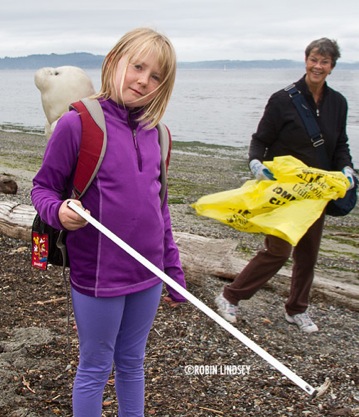
Because yesterday was such a dreary, rainy day with not too many beach-goers, there was not the typical overflow of Friday night garbage strewn all over the sidewalks and beach. However, we assured everyone they would find lots of small, harmful trash - including many cigarette butts. In fact, well over an estimated thousand cigarette butts were picked up in a matter of hours along with plastics and paper.
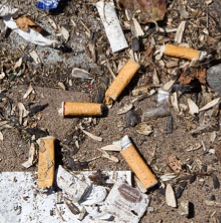
The beach cleanup was a great success - all in all, over 100 hours of volunteer time were donated this morning (we’re still tallying the hours) to help keep all of us and the wildlife we love safe. We thank everyone for their hard work and passion! And a special thanks to SS hotline guru Larry Carpenter for puling everything together to make this happen.
"Sentinels of the Sound" beach cleanup in honor of seal pup Sandy
Harbor seals (who do not migrate and are year-round residents) and orcas, both animals at the top of the food chain, are especially hard hit by pollutants from storm runoff and microplastics which are stored in their blubber. A 2005 study showed that harbor seals of South Puget Sound were 7 times more contaminated with PCBs than those of Canada's Georgia Strait. The orcas of Puget Sound are the most contaminated marine mammals in the world.
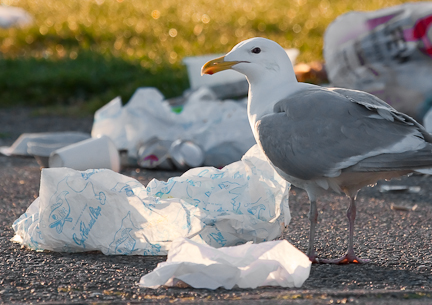
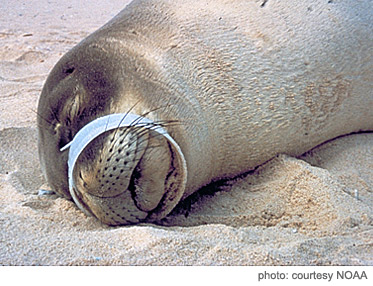
All marine life is endangered by marine debris and pollution. Many, many thousands of marine animals and sea birds die each year from derelict fishing gear, marine debris and pollution. They are entangled and drowned by nets and gear. Strangled and contaminated by plastics.
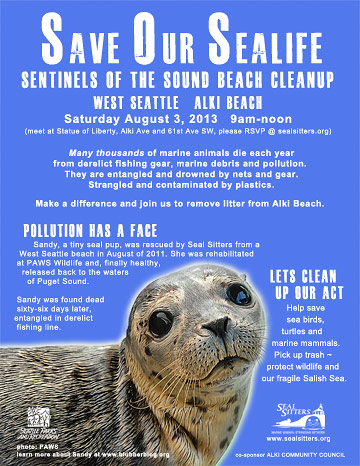
This year's beach cleanup events will once again be in honor of seal pup Sandy who was rescued from a West Seattle beach in August of 2011, rehabilitated at PAWS Wildlife Center, and then released back to the wild in January of 2012. Sandy was fitted with a satellite tag (glued to her fur which would be shed when she molted) to monitor her success in the wild and provide valuable data to biologists about foraging patterns of rehabbed seals. Sixty-six days later, Sandy was found dead, entangled in derlict fishing line off the Edmonds Pier. Read more about Sandy.
Sandy has truly put a face on pollution. Trash on the beach becomes treacherous in the water. You can make a difference! Help keep our beaches clean and our sea life safe. Read more about marine pollution here.
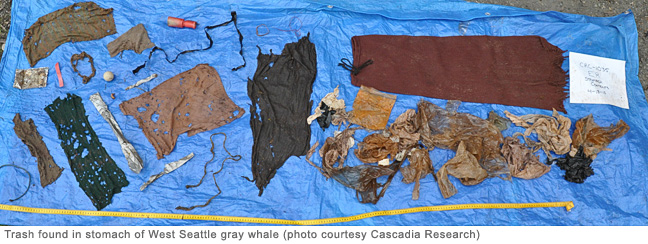
We would also like to honor the memory of the Arroyos gray whale who stranded and died in 2010. The necropsy revealed that there was no food in the thin juvenile male's stomach - only human trash.
Seal Sitters, along with co-sponsors Alki Community Council and Seattle Department of Parks and Recreation, will hold a cleanup of West Seattle's Alki Beach on Saturday, August 3 from 9am-noon. We will assemble at Alki's Statue of Liberty plaza (61st Ave SW and Alki Ave SW). Please RSVP for this event so we have enough bags and equipment on hand.
Read about last year's event here.
Beach cleanup a big success as volunteers honor seal pup Sandy
While the beach did not appear to be as littered as usual on a summer Saturday morning due to a rather rainy Friday, the volunteers filled about 10 large trash bags. They picked up many cans, plastic bottles and caps, countless cigarette butts, and among other things a kayak paddle, a woman's black and pink bra and dirty diapers. Students from UW's Environmental Studies program each donated over 3 hours of their time, picking up bags of trash including spent fireworks on Constellation Beach - fireworks that leave toxic residue and contaminate the Sound. We even had a family drive all the way from Ellensburg, well over 100 miles each way, just to pick up trash on the beach! Brooklyn, the "almost" 9 year old daughter, read about seals on our website, saw the post about Sandy and told her mom and dad (super-parents Vanessa and Kevin) that she wanted to come help seal pups by cleaning up the beach. We can't thank everyone enough for helping out. A total of 128.5 hours were donated yesterday morning. All of these volunteers are a true inspiration and made a difference for our sea life. Special kudos to SS vols David and Eilene Hutchinson and Larry Carpenter.
Find out more about the dangers of marine pollution on Seal Sitters’ website.
Alki Beach cleanup in honor of seal pup Sandy
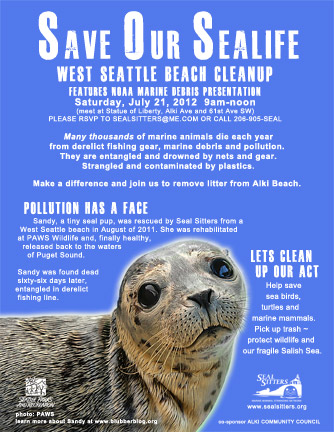
Sandy the seal pup truly puts a face on the dangers of marine pollution and trash. You may also remember the young gray whale that stranded and died on Arroyos Beach - the only contents in his stomach were human trash. Please make a difference and join us. Countless thousands of marine animals die as a result of marine debris, trash and pollution. Trash that is on the beach becomes treacherous in the sea. Read more about marine pollution on Seal Sitters’ website.
Peggy Foreman of NOAA will discuss the dangers of marine debris and pollution shortly after we assemble at 9am. We will meet at the Statue of Liberty (next to the Alki Bathhouse on Alki Beach 61st Ave SW and Alki Avenue SW). Please rsvp for this event as Parks will be providing trash grabbers and buckets for participants.
To print out a copy of this flyer to post at your work or business, please click here. The flyer is a full bleed and may need to be set at “reduce to fit” for some inkjet printers.
Divers recover seal pup Sandy's body for necropsy
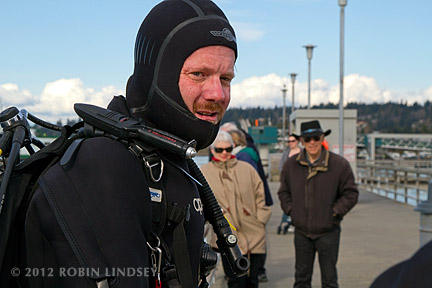
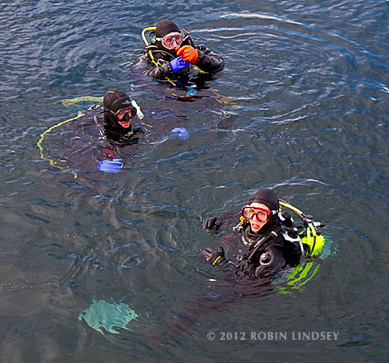
Yesterday, while the MaST team searched the cold waters below (photo right), Seal Sitters’ lead investigator was stationed up on the pier to keep them safe from fishermen’s casts. She had an enlightening conversation with lone fisherman Nick about derelict lines and lures. According to Nick, there are a number of large tires that have been sunk off the pier in order to create habitat for fish. While fish have indeed become abundant in this habitat, the problem is that lures are constantly getting caught on the rubber tires and fishermen can’t reel them back in. Much to the frustration of the fishermen, the lines then have to be cut, leaving a maze of ebbing monofilament, hooks and lures which put marine mammals and sea birds at great risk. Nick said that Des Moines had sunk tires as well years ago, but finally removed them all. It was his and other fishermen’s opinion that Edmonds should follow suit. When the MaST team completed the dive, Sandy in tow, the divers mentioned the amazing amount and variety of large game fish in the habitat - and where there are big fish, there are usually the small bait fish that seal pups prefer.
While the Edmonds pier situation appears irreparable without removal of the tire habitat, Seal Sitters has noticed that the fishing piers in West Seattle (Water Taxi and Duwamish Head piers) are often strewn with cut line and hooks. There are a number of sea gulls seen by the piers with only one leg - the direct result of having line sever a leg. Volunteers David and Eilene recently removed line from the leg of a gull. Lincoln Park’s favorite fishing hole by Colman Pool is littered with line and hooks everywhere when the fish are running. We respectfully ask that fishermen please be more careful and not leave derelict gear. Not only are seal pups and gulls endangered - so are people and other animals.
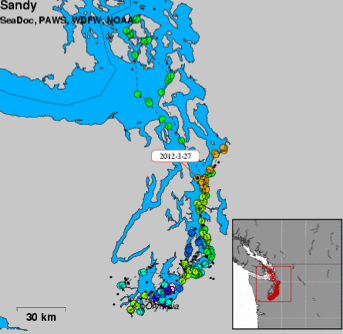
Huge thanks to MaST’s stranding team Rus, Kaddee and Arthur for recovering “satellite” Sandy, whose movements were followed by almost 600 residents of Puget Sound via her SeaDoc Society dedicated web page. The satellite revealed that Sandy travelled 990 kilometers (615 miles) in the 66 days she swam free in the wild. The death of Sandy has truly put a face on the dangers of marine debris and derelict fishing gear. Seal Sitters intends to dedicate our annual beach cleanups in her memory. We hope you will join us.
Derelict fishing gear dangers - and what to do
If by sad chance, you see a dead marine mammal entangled in gear, get a photo if possible. If the animal is tagged and you can do it safely, try to get a photo of the tag number. Do not put yourself in danger to do so. Do not attempt to remove the animal or the fishing gear. Email the photo of the animal to Kristin Wilkinson, NOAA’s NW Marine Mammal Stranding Expert, along with lat/long information. To report only derelict gear, please contact NW Straits - they are the experts at removal.
What should you do if you encounter a live entangled animal? First, if at all possible, call the NOAA stranding network @ 800-853-1964 (in the West Seattle area call 206-905-7325). Keep in mind that most of the networks do not have boats or divers readily available for that type of response except in matters of whales. We want to stress the inherent danger in trying to free an animal. If you insist on proceeding at your own risk in this highly dangerous task, NOAA’s Good Samaritan clause will protect you from Federal prosecution for the “take” of a marine mammal (Marine Mammal Protection Act). The Good Samaritan exemption is as follows (found on NOAA website):
It shall not be a violation of this chapter to take a marine mammal if:
1) such taking is imminently necessary to avoid serious injury, additional injury, or death to a marine mammal entangled in fishing gear or debris
2) reasonable care is taken to ensure the safe release of the marine mammal, taking into consideration the equipment, expertise and conditions at hand
3) reasonable care is exercised to prevent any further injury to the marine mammal and
4) such taking is reported within 48 hours
Please note: This MMPA exemption does not protect you from liability of monetary damages from the owner of the net or fishing gear.
We cannot say enough how tremendously dangerous fishing gear is to all living things - including you. The last thing we want is a human tragedy on top of this environmental one.
Seal pup Sandy drowns in fishing gear
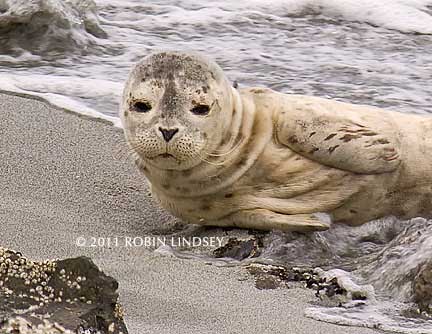
Sandy was only three weeks old, weighing 7.1 kgs (a third of normal body weight for a nursing pup), when she was rescued by Seal Sitters from a West Seattle beach on August 15, 2011 (photo right). She spent a lengthy 5 month rehab at PAWS, but was a robust pup when finally released at a harbor seal rookery in South Puget Sound. Through the combined efforts of PAWS, NOAA, SeaDoc Society and WDFW Marine Mammal Investigations, Sandy was fitted with the satellite tag in order to provide valuable data to researchers. The satellite revealed she stayed relatively close to the release point for the first few days, but then she began taking off on adventures - south to Olympia, north to the San Juans, circling Vashon, back to Olympia and Shelton, up to Edmonds a couple of times. After being in a small pool for so many months, it seemed as though she had the travel bug and appeared to be thriving in the wild (map below shows her travels). The last satellite hit was on the 27th.
Sandy is not the only harbor seal with a West Seattle connection to die from fishing gear. A few days before we rescued her last August, we responded to a dead adult female on Beach Drive. The necropsy showed that the female had given birth within ten days or so and the cause of death was from fishing line and lure, twisting the female’s stomach and causing an agonizing death. A newborn pup we nicknamed Tiny died on another beach the same day as the necropsy. It is not beyond the realm of speculation that Tiny was this female’s pup and that fishing gear caused the death of both animals.
This is truly a very sad day. Special thanks to PAWS’ staff who nursed Sandy back to health and cared for her for so many months. For those of us who participated in her release, we will never forget the joy of seeing her swimming free in the Sound with that little yellow-green satellite hat. SS volunteers and Puget Sound residents signed up to receive SeaDoc Society email alerts and excitedly followed her movements online. To read more about Sandy and view the video of her release back to the wild, click here.
To learn more about the dangers of marine debris and how you can help, click here.
NOTE TO DIVERS:
If you are a diver and come upon animals who have died in derelict gear, we ask two things. First, please take a photograph and email a jpg to us. We will forward the photos to the appropriate person for a corresponding database - this will greatly help assess the true number of animals that perish each year. Secondly, please indicate the location of the derelict gear if you have lat/long finder and we will report it to the Northwest Straits Derelict Fishing Gear Removal Program which estimates that 50,000 animals are entangled and die each year in Washington waters just in shallow water nets and gear (excluding an unknown number in deep-water derelict gear). Harbor seals had by far the highest number of deaths among marine mammals in gear they removed. According to their website :
As of November 30, 2011, the Northwest Straits Initiative has removed 4,081 derelict fishing nets and 2,668 crab pots from Puget Sound, restoring 596 acres of critical marine habitat. Over 241,700 animals, representing more than 240 species, were found entangled in this gear.
Please spread this message among your diving community and make a difference for the marine mammals of Washington. Do not attempt to remove fishing gear - it is extremely dangerous. NW Straits has informed us that a diver drowned in Puget Sound a few years ago on a sport fishing line cleanup.
Lend a hand for beach cleanup and save marine life
NOAA has produced several children’s activity booklets about marine debris that are available here for download: Protect the Ocean and Understanding Marine Debris. Both contain puzzles and illustrations that help kids understand the importance of keeping the beaches and marine waters free of trash - so that sea life will be here for many generations to come!
Thanks to the Americorps (Washington Reading Corps of South King County) volunteers who will be participating in the beach cleanup as well as members of ACC and Seal Sitters. This event is open to the public and all those interested in making a difference for the environment. If you, your group, or class would like to lend a hand, meet us at the Statue of Liberty across from Starbucks (Alki Ave SW near 61st) at 9am. If you have questions, please contact Larry Carpenter @ 206-938-0887. Special thanks to Carol Baker and Colleen Hackett of Seattle Parks for providing cleanup tools. Tully’s, Starbucks and Pioneer Coffee are all generously donating coffee to keep our volunteers warm and energized throughout the morning. We hope to see you there!
Early morning wake-up call
Gray whale necropsy reveals trash inside stomach
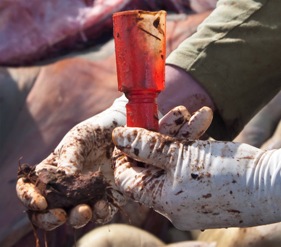
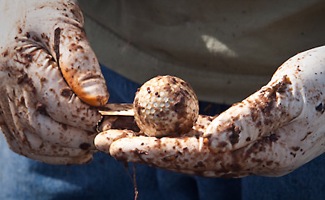
The public should give many thanks to the necropsy team for performing this incredibly important and physically strenuous work. Due to their dedication and efforts, we are now aware of the role that pollution may have played in the death of this whale - as it indeed impacts all our marine life. Plastics that end up in our waters never go away - they eventually end up as micro particles which absorb contaminants and enter the marine food chain, causing deformities and disease. It is well known that our local seals and orcas are laced with pcbs and other toxic chemicals. Depletion of food sources caused by commercial overfishing and pollution can be reversed by getting involved. You CAN make a difference - pick up trash on the beach, don’t purchase seafood on the seafood watch list and ask your grocer not to sell it, help clean up the Sound.
As an observer, our volunteer was stunned at the amount of trash that was removed from the whale - and overwhelmed with sadness that human impact had, in any way, contributed to this whale’s demise. Please learn more about our polluted waters and the Great Pacific Garbage Patch, an oceanic swirling mass of plastic twice the size of Texas, on Seal Sitters’ website. Educate people about the dangers of pollution and its tragic impact on our wildlife now and for generations to come. Make a commitment that this magnificent whale’s life was not given in vain.
See news video here.
Read Lynda Mape’s excellent article in the Seattle Times.