molting
Finally - a chubby seal pup to lift volunteers' spirits
Oct/12/13 10:23 PM
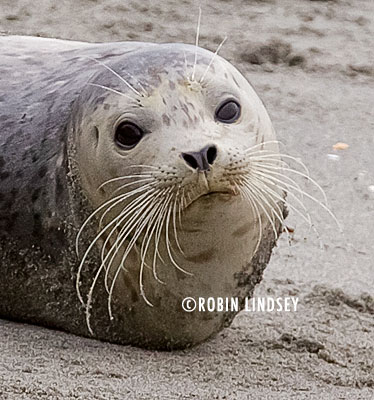
Tiger shows off a magnificent set of whiskers which he will shed next year during his first molt. Since newborn harbor seal pups shed a long and wavy white lanugo coat inside the womb (unless born prematurely), he will not be molting his new spotted fur until next season. However, once a pup reaches a year old, he will shed all his fur and whiskers (called vibrissae) annually over a period of one-two months immediately following breeding season. It takes many months for the whiskers to reach full length again. Seals do use their vibrissae to help them locate and identify prey by sensing motion, but during the very uncomfortable molt they tend to stay onshore for the most part and rely on fat storage for energy. This is why it is critical for seals to bulk up before the late fall and winter months since their weight will drop during the molt.
Seal pups on shore briefly today and others hanging around
Oct/11/13 09:47 PM
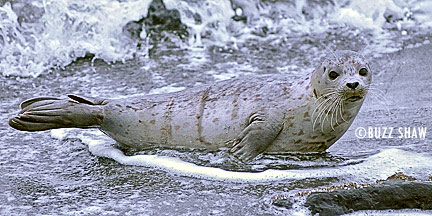
Later in the afternoon, 4 pups were observed foraging along the shoreline, but none that we know of came ashore. A pup was also sighted briefly on the protected beach at Jack Block Park. Perhaps the pups are resting at night or in locations that are less visible. The good news is, however, that we have pups still hanging around West Seattle and that they seem to be actively feeding. In the photo you can see Tiger’s long whiskers which detect vibrations from prey in the water. A recent study showed that the highly sensitive vibrissae contain thousands of nerves which enable a seal not only to locate prey, but determine size and species. This is why harbor seals are very effective hunters even at night or in deep, dark waters.
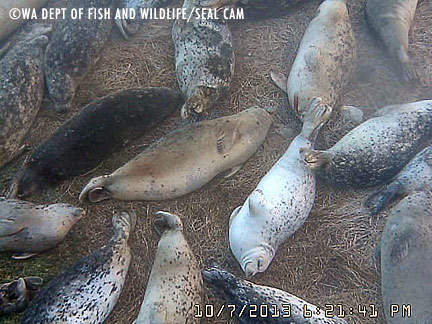
Haul-outs this time of year are not a welcoming place for new “weaners” to linger. All the more reason we need to offer them sanctuary on our urban beaches.
Molting elephant seal finds secret hideaway
Jan/13/12 09:59 AM
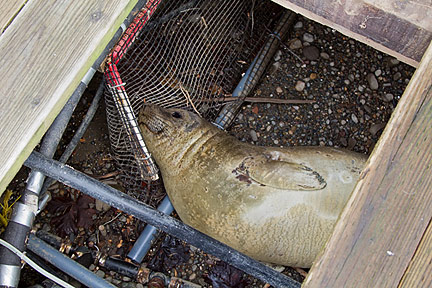
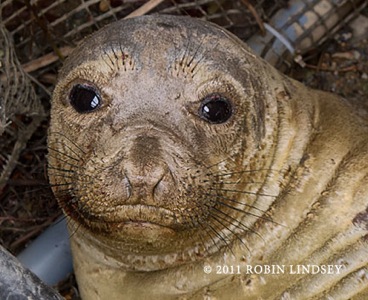
Northern elephant seals are the largest pinniped found in NW waters. The breeding rookeries are located in California and Mexico; however, after the winter breeding season and annual molt, individuals disperse northward along the Oregon and Washington coasts. Small numbers have settled in Puget Sound and use beaches at Destruction Island, Protection Island, Smith and Minor Islands and Dungeness Spit. Births of pups have been recorded at these sites as well.
Molting elephant seal at Golden Gardens
Jun/03/11 07:30 PM
(see update end of story) Seal Sitters responded to calls yesterday of an injured seal at Golden Gardens in Ballard. The first call came in about 3:30 pm but the seal could not be found. Another report came in approximately 7 pm that a seal with “stomach wounds” was on the boat launch at Shilshole Marina. Our responder could not find the seal there, however, noticed a group of people further down the sandy beach who were too close to what turned out to be an elephant seal. Our responder established a large tape perimeter on the beach and proceeded to get a health assessment through observations and video/still images. The seal was obviously going through an unusually difficult molt, but was lying on his/her stomach - hence there was no way to determine if there were indeed wounds or if it was fur and skin missing from the molting process. The seal was alert, but thin and exhibiting typical elephant seal behavior of flipping sand on sides and back. Volunteers watched over the seal (unable to determine sex, but could be either female or juvenile male) until after dark and bystanders were respectful, concerned and inquisitive.
We have embedded a short video clip of the seal who was still on the beach at daybreak this morning. Most of the photos are a bit too gruesome to share since elephant seals’ catastrophic molt (shedding skin and fur all at once) is an ordeal where people often think they are dying. This seal was undergoing a particularly horrific molt with what appeared to be related health issues. The seal returned to the water late morning as the beach became busy with noisy onlookers. One could see the animal’s stress level rise significantly as people talked and moved about and were in the water just on the other side of the protective yellow tape barricade. Please remember that while NOAA recommends staying 100 yards away from any marine mammal on shore, the network tries to establish a reasonable perimeter that protects the seal while not drastically inconveniencing urban beachcombers. This, however, does not mean that it is appropriate to create disturbances close to the tape. Given the extreme low tides and expected nice weather this weekend, we hope this seal finds a quieter place to rest. If you see the seal, please call our hotline @ 206-905-SEAL (7325) immediately and ask people to observe quietly from a distance.
UPDATE: Review of still images by marine mammal experts Friday morning determined that this seal is suffering from at least a moderate case of Northern Elephant Seal Skin Disease (NESDD), which can cause secondary infections and septis and, if left untreated, can be fatal. Sometimes referred to as “scabby molt”, almost all reported cases have been found in 1 - 2 year old elephant seals. Plans had been set into place to relocate the animal to a quieter spot, obtain blood samples and, at the very least, scrub the skin with an anti-bacterial topical solution. Since Washington State has no marine mammal rehab facility, efforts were being made to find a regional facility who might be able to hold and treat the seal more long-term with antibiotics. Unfortunately, before the biologist could arrive to relocate the seal, he/she returned to Puget Sound. Video of the seal leaving the beach further supported the conclusion that the seal was extremely weak and compromised.
UPDATE: Review of still images by marine mammal experts Friday morning determined that this seal is suffering from at least a moderate case of Northern Elephant Seal Skin Disease (NESDD), which can cause secondary infections and septis and, if left untreated, can be fatal. Sometimes referred to as “scabby molt”, almost all reported cases have been found in 1 - 2 year old elephant seals. Plans had been set into place to relocate the animal to a quieter spot, obtain blood samples and, at the very least, scrub the skin with an anti-bacterial topical solution. Since Washington State has no marine mammal rehab facility, efforts were being made to find a regional facility who might be able to hold and treat the seal more long-term with antibiotics. Unfortunately, before the biologist could arrive to relocate the seal, he/she returned to Puget Sound. Video of the seal leaving the beach further supported the conclusion that the seal was extremely weak and compromised.
Abby the ellie's back in town
Mar/11/11 09:25 PM
Neighbors are keeping a watchful eye over her and spreading the word that dogs need to be on a leash. Volunteers will be monitoring her as necessary. Abby will likely be there for a number of days, tossing sand over her body.
UPDATE: 3/12 7am
Abby was not on the beach at daybreak this morning. There were, however, a number of huge paw prints where she had been hauled out. We hope that the off leash dog was there after she returned to the water.
Abby returns to the Salish Sea after stormy night
Feb/07/11 10:04 PM
Abby the ellie still resting on private beach
Feb/06/11 09:20 PM
Elephant seal seeks quiet beach to molt
Feb/04/11 08:54 PM
Molting is a process of shedding the skin and fur. Seals shed their fur each year and harbor seals molt shortly after the breeding season over a period of about 4 weeks. For the elephant seal, however, molting is a grueling endeavor. Every year they shed not only their fur, but also the first layer of skin in a matter of weeks. It is such an abrupt process, taking place in a very short length of time, that it is called a catastrophic molt. As you can imagine, it is terribly uncomfortable and painful. During that time, the seal typically remains on the beach and does not return to the water to forage until the molt is complete. The animal is generally pretty miserable and it is a disturbing sight to the public, but be assured that this seal is quite healthy and will soon have a beautiful, new svelte coat. This elephant seal has been nicknamed Abby. We are pretty sure the seal is female but have not completely verified that. If Abby turns out to be male, we will have to change the name to Fat Albert because this is one very, very rotund seal! Certainly there are no worries that this seal won’t have enough blubber to last through the fast. It is conceivable that this is the same female who chose this quiet spot to molt last year.
Unfortunately, like all too many West Seattle beaches, illegally off leash dogs are a real concern. Volunteers and residents intercepted a number of dogs who were headed straight for Abby. Unlike small seal pups who usually end up injured in this scenario, this elephant seal is several hundred pounds and not feeling well. It could easily end up that both the dog and Abby could get severely injured as she tries to defend herself. We want to ensure that Abby is able to rest as discreetly and safely as possible during her trying time. It is part of Seal Sitters’ role in the marine mammal stranding network to help keep both the animals and the public safe at all times.